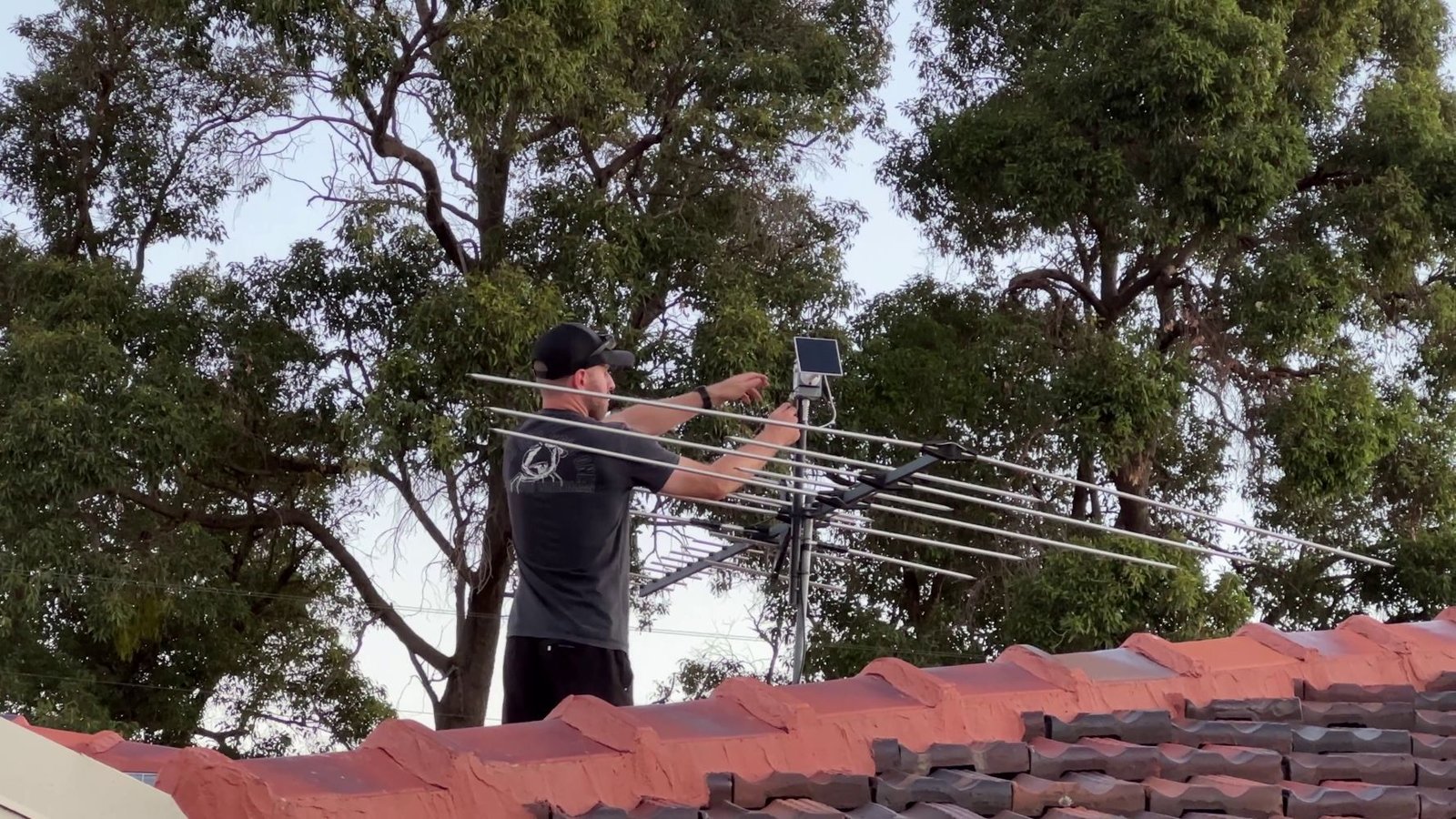
If you’re replacing the antenna on a Meshtastic or MeshCore node, start with a decent whip matched to your frequency and connector. These are the four antennas I’d consider, from handheld whips to fixed outdoor repeater antennas. The GIZONT is my first pick for handhelds; the Alfa is worth a look for fixed installations.
Meshtastic and MeshCore can use the same antenna if the frequency and connector are suitable. You do not need a special “MeshCore antenna”. Match the frequency and connector first. Then think about where the antenna will sit.
Best LoRa antennas: quick picks
- Best for handhelds: GIZONT 17 cm whip. My budget pick for replacing a stock antenna.
- Best foldable handheld: CDEBYTE TX915-JKD-20. A longer hinged whip you can fold away.
- Best for fixed nodes: Alfa AOA-915-5ACM. A compact antenna for a suitable mounted setup.
- Best for outdoor repeaters: CDEBYTE TX915-BLG-26. A fibreglass option for a short mast installation.
GIZONT 17 cm whip: best budget handheld

The GIZONT 17 cm whip is my first pick for replacing the short antenna supplied with many handheld LoRa radios. It’s on Meshtastic’s community antenna list and is an affordable starting point. Choose the frequency version that matches your radio and check the SMA connector before ordering.
CDEBYTE TX915-JKD-20: best foldable handheld

The CDEBYTE TX915-JKD-20 is a 200 mm foldable 915 MHz whip with an SMA male connector. I’d choose it when you want a longer antenna that you can angle or fold away while carrying a radio. It also appears on Meshtastic’s community antenna list. Check your device’s connector before buying.
Alfa AOA-915-5ACM: best compact fixed node

For a fixed node, the Alfa AOA-915-5ACM is a solid option covering 902–928 MHz. It uses an N-type connector rather than the SMA socket found on many handhelds, so allow for the right cable and mounting hardware. Mount it somewhere clear of nearby metal.
CDEBYTE TX915-BLG-26: best compact outdoor repeater

For a compact outdoor repeater, the CDEBYTE TX915-BLG-26 is a manageable fibreglass option. Its published specifications list 915 MHz operation, 3 dBi gain and an N-male connector. It’s easier to accommodate than a tall base-station antenna, provided you have a suitable mounting point and cable.
Get the frequency right first
An antenna is designed to work best over a particular frequency range. Many Meshtastic and MeshCore devices are sold with radios intended for the 868 MHz or 915 MHz regions, but the actual channel frequency depends on your local configuration. A product labelled merely “LoRa antenna” is not enough information.
- Check the configured radio frequency or regional preset, not just the country printed on the box.
- For networks using 902–928 MHz, look for a specified operating range that actually covers the frequency you use.
- For European 868 MHz operation, buy an 868 MHz antenna rather than assuming a 915 MHz whip is interchangeable.
- Make sure your node’s radio hardware also supports the selected band; changing an antenna does not change the radio’s supported frequencies.
In Australia, the correct setup depends on your equipment, the applicable radio rules and the community network settings. Check current requirements and approved radio parameters rather than copying overseas power settings. For context, see MeshCore’s frequency FAQ and the Meshtastic radio configuration documentation.
What antenna gain actually changes
Antenna gain, expressed in dBi, describes how radiation is concentrated relative to an ideal isotropic antenna. A higher-gain vertical omnidirectional antenna tends to focus energy into a flatter pattern around the horizon. That can suit a rooftop repeater serving distant, similar-height nodes, but it may be a poor fit for a handheld used on hills or among buildings.
| Style | Typical advantage | Trade-off |
|---|---|---|
| Short whip / low gain | Portable, broad vertical coverage | Can be compromised by placement and the device enclosure |
| Medium-gain omni | Good general-purpose choice for fixed nodes | Still needs sensible mounting and coax |
| High-gain omni | Potentially useful on relatively flat, open terrain | Narrower vertical coverage; power and legal limits matter |
| Directional panel / Yagi | Concentrates coverage towards a known destination | Requires alignment and does not cover all directions |
Don’t buy an antenna just because the listing advertises more dBi. A well-placed whip can beat a larger antenna mounted in a poor position.
Check the connector: SMA, RP-SMA and U.FL
SMA and RP-SMA can look confusingly similar. The centre pin arrangement differs; adapters can also introduce loss or mechanical strain. Some development boards use a tiny U.FL/I-PEX connector on the PCB with a short pigtail running to a bulkhead connector.
- Look at the centre pin and socket on both mating parts, not only the external thread.
- Check whether an antenna listing specifies SMA male, SMA female, RP-SMA male or RP-SMA female.
- Avoid frequently unplugging tiny U.FL connectors; they are not intended for endless mating cycles.
- For an outdoor installation, use an appropriate bulkhead fitting and seal the weather-exposed connection without trapping moisture.
Important: Connect a suitable antenna before powering or transmitting from a LoRa node. The official Meshtastic getting-started guide warns that operating without an antenna can damage the radio.
Mounting and cable loss matter
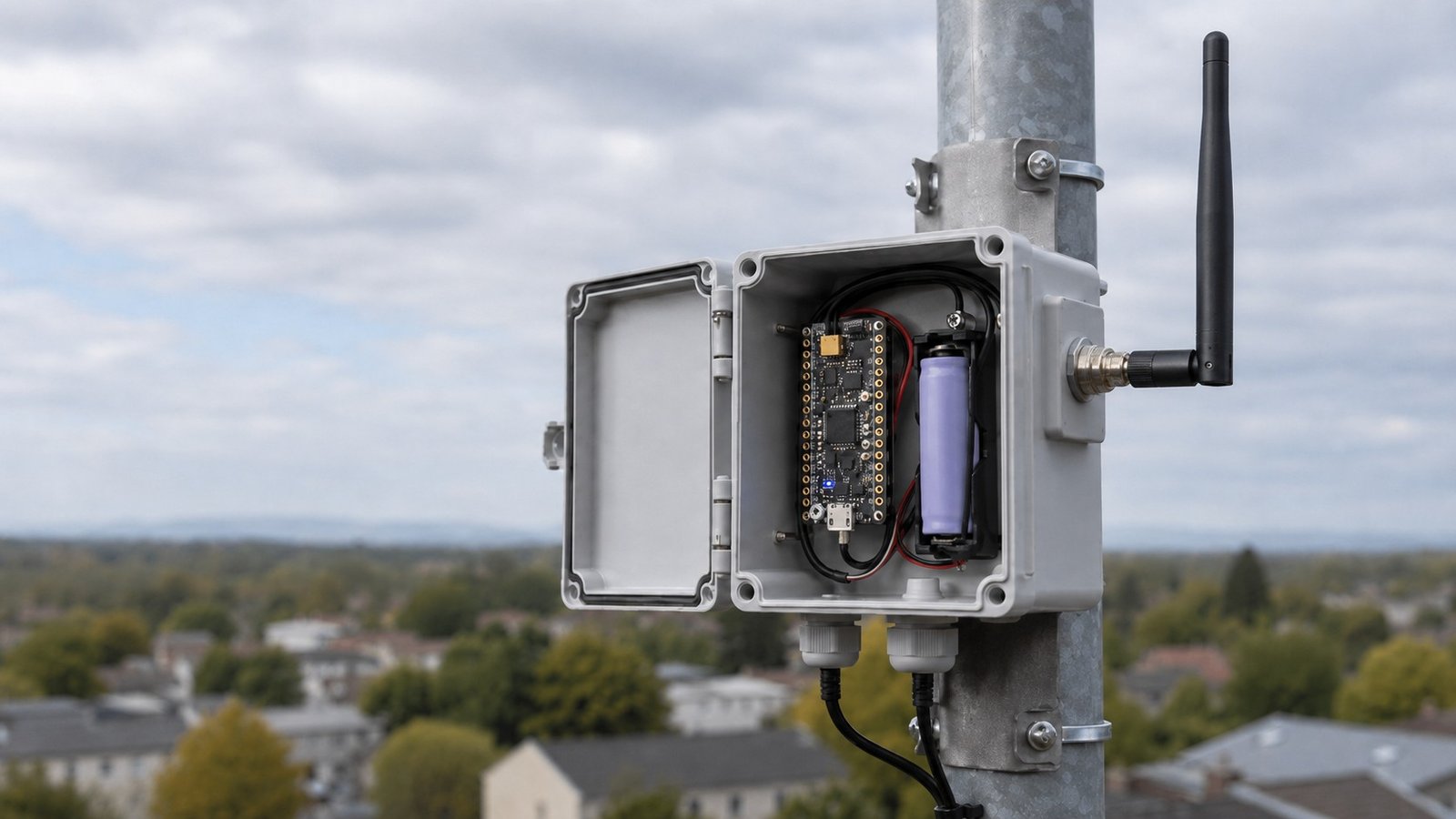
Imagine putting a high-gain antenna on the roof but running a long, thin coaxial cable down into the building. At around 900 MHz, cable attenuation can consume much of the theoretical antenna advantage. Longer runs also add connectors and weatherproofing points.
- Put the antenna above nearby obstructions where safe and practical.
- Use the shortest reasonable run of good-quality, 50-ohm coaxial cable.
- Compare the manufacturer’s attenuation figure at your operating frequency, expressed in dB per metre.
- Keep vertical antennas vertical unless the other end of the link calls for a different polarisation.
- Maintain suitable separation from metal and other antennas according to the product installation requirements.
- For an exposed mast, consider appropriate earthing, surge protection and professional installation.
Often a small waterproof enclosure with the entire radio mounted near the antenna is a better engineering choice than several metres of poor-quality coax. Think about how the unit will be powered and serviced before doing that.
How I’d compare two antennas
When comparing two antennas, leave the radio settings and mounting position alone. Otherwise, you won’t know which change made the difference.
- Record the starting radio settings and antenna.
- Use one or more fixed test locations with a known, stable receiving node.
- Record packet success, RSSI and SNR where the firmware exposes them.
- Repeat a consistent set of transmissions under similar conditions.
- Swap the antenna without moving the radio or modifying the settings.
- Repeat the test at several distances and, ideally, over more than one session.
RSSI alone is not a complete performance measure. Pay attention to reception reliability, SNR, local interference and variation between test runs. A vector network analyser, including a NanoVNA, can help spot a badly matched antenna. A good VSWR reading still doesn’t guarantee good range.
Common antenna buying mistakes
- Buying an 868 MHz antenna for a 915 MHz network, or vice versa.
- Assuming the tallest whip or highest advertised gain must be best.
- Using the wrong SMA/RP-SMA centre-contact arrangement.
- Leaving a fixed antenna behind metal or inside a difficult RF environment.
- Running long, lossy coax from a well-placed antenna to the radio.
- Assuming the antenna solves a firmware, power, LoRa preset or node-configuration problem.
- Using a high-gain setup without checking applicable effective radiated power limits.
Frequently asked questions
Do Meshtastic and MeshCore need different antennas?
No. For antennas, the important factors are the actual RF frequency, impedance, connector, placement and intended coverage pattern. The firmware itself does not demand a different antenna.
Will a 5 dBi antenna double my range?
Not reliably. Radio coverage depends on terrain, obstacles, antenna height, signal-to-noise ratio, cable loss and the other node. Gain figures do not translate directly into a fixed distance multiplier.
Is a 915 MHz antenna suitable in Australia?
It can be, if its specified operating band covers your actual configured frequency and your transmitter setup complies with applicable Australian rules. Check the exact antenna specification and regional radio settings.
Should I replace the antenna that came with my LoRa board?
If range is disappointing or you don’t trust the bundled whip, the GIZONT is an easy starting upgrade for a handheld. If coverage is already good, there’s no reason to replace an antenna that works.
Which antenna I’d buy
For a handheld, I’d choose the GIZONT 17 cm whip. If you want a foldable antenna, the CDEBYTE TX915-JKD-20 is another good option. For a small fixed node, I’d look at the Alfa AOA-915-5ACM, while the CDEBYTE TX915-BLG-26 is a practical outdoor repeater option. Match the frequency and connector before ordering.
If you’re still choosing hardware, see my best Meshtastic devices and best MeshCore devices comparisons. To understand where antennas fit into the wider network, read MeshCore explained or my repeater setup guide.
About the antenna recommendations
I haven’t compared every antenna listed here side by side. If you want measured results, see the Meshtastic antenna resources and community antenna test reports. Performance can vary with the installation, so those tests are a useful starting point rather than a substitute for testing on your own network.
Some of the links in this post may be affiliate links. If you buy through them, I may earn a small commission at no extra cost to you.