MeshCore and Meshtastic are both LoRa mesh projects for off-grid messaging, but they suit different kinds of networks. Meshtastic is usually the easier option if you want a polished phone-first experience, broad hardware support and something you can hand to friends without much explanation. MeshCore makes more sense when you care about dedicated repeaters, tighter control over how traffic moves and keeping a larger mesh quieter.
For casual messaging, hiking and quick setup, I would still start with Meshtastic. For planned repeaters, remote properties and infrastructure-style deployments, I think MeshCore has the stronger design. The comparison below breaks down where each one actually differs and when those differences matter.
MeshCore vs Meshtastic comparison table
If you want the short version first, this table covers the main differences between MeshCore and Meshtastic before we go deeper into setup, routing, airtime, apps, and real-world use cases.
| Category | MeshCore | Meshtastic |
|---|---|---|
| Overall focus | Structured, role-based LoRa mesh with more deliberate network behaviour | General-purpose LoRa mesh with a stronger phone-app and end-user focus |
| Best fit | Planned repeaters, remote properties, fixed infrastructure and network tinkerers | Beginners, hiking, travel, casual messaging and ad hoc groups |
| Setup | Easy enough for a companion node, but more involved once you build out repeaters and other roles | Usually the quicker route from new hardware to a working phone-based mesh |
| Routing and repeating | Dedicated repeaters remain central to the design. Companion nodes normally do not repeat on the structured mesh, although optional companion repeat mode exists for specific off-grid scenarios | Uses node roles, managed flooding and routed direct messages. Router and repeater roles need sensible placement |
| Apps and user experience | Android, iPhone and web clients, with more emphasis on operating a structured radio network | Polished Android, Apple and web experience with messaging, maps and node discovery front and centre |
| Hardware support | Supports many useful LoRa boards, but the ecosystem is smaller | Broader supported-device ecosystem and more ready-made hardware choices |
| Busy or dense meshes | Strong fit when deliberate repeaters and tighter control of airtime matter | Works well, but busy meshes need more care around traffic, roles and channel utilisation |
| Range | On the same LoRa hardware, antenna and equivalent radio settings, neither platform has a magic RF range advantage. Placement, antenna quality, terrain and the relay network matter more | |
| Home Assistant | Growing custom-integration and self-hosting ecosystem, but still less mature | More mature today, with official MQTT guidance plus a Meshtastic-maintained HACS integration |
| Hiking and travel | Works, especially with companion repeat mode where appropriate, but is not usually the easiest casual-group option | Usually the better starting point for portable group messaging and maps |
| Fixed infrastructure | One of its strongest use cases | Capable, but less centred on dedicated infrastructure roles |
| Can they talk to each other? | No. MeshCore and Meshtastic use different firmware and networking protocols. Some radios support both, but the device must be flashed for one platform at a time | |
| Main trade-off | More deliberate network design, but a smaller ecosystem | Easier onboarding and broader adoption, but less infrastructure-focused |
What MeshCore is
MeshCore is a multi-platform off-grid communication system built on LoRa hardware, with a strong focus on reliability, efficiency, and structured network behaviour. The project positions itself around secure text communication, emergency and off-grid use, outdoor use, and IoT-style sensor networks, but what really defines it in practice is how deliberately it separates node roles.
The core MeshCore roles are companion radios, repeaters, and room servers. Companion radios are the client-side radios that connect to a phone or computer over Bluetooth or USB serial. Repeaters exist specifically to extend range and forward traffic toward the destination. Room servers add a simple BBS-style shared posting model and can deliver previously unseen posts when a client logs in. Companion nodes normally do not repeat traffic on the standard structured mesh, which is one of MeshCore’s defining design choices, although newer firmware also supports an optional companion repeat mode for specific off-grid scenarios where dedicated repeater infrastructure is unavailable.
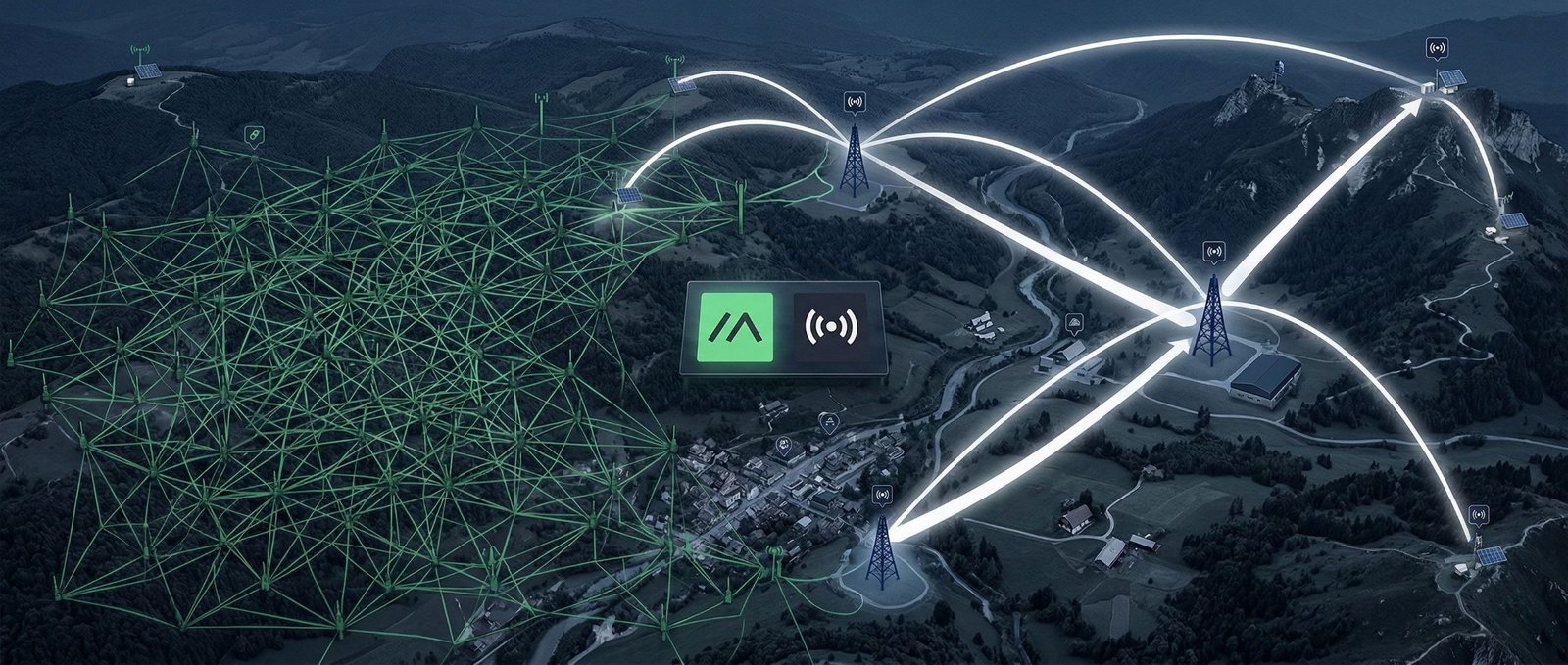
In practice, MeshCore feels less like “everyone turns on a node and joins a chat mesh” and more like “you build a network with purpose.” A companion node might live in your pocket, a repeater might go on a roof or hill, and a room server might sit at a fixed site. That makes it especially attractive for remote properties, local infrastructure builds, repeatable field deployments, and maker projects where you want control over behaviour instead of hoping the mesh sorts itself out.
What Meshtastic is
Meshtastic is also a LoRa mesh communication platform, but it is much more app-centric and socially approachable. You connect a supported radio to your phone or computer over Bluetooth, WiFi, USB, or Ethernet and use it for messaging, maps, node discovery, telemetry, and location sharing without internet or cellular service.
The Android app is built around conversations, node lists, a mesh map, settings, and connection management. The project also has Apple apps, a browser-based web client, a Python CLI, and device-side UI support through Meshtastic UI on supported hardware. In other words, the project has grown into a broad ecosystem, not just a firmware image.
In day-to-day use, Meshtastic usually feels more like an off-grid messaging platform than a network architecture exercise. That is part of its appeal. Flash a radio, pair it, set your region and channel, and you can get useful results quickly. For a lot of people, especially beginners, that alone is enough to make it the obvious place to start.
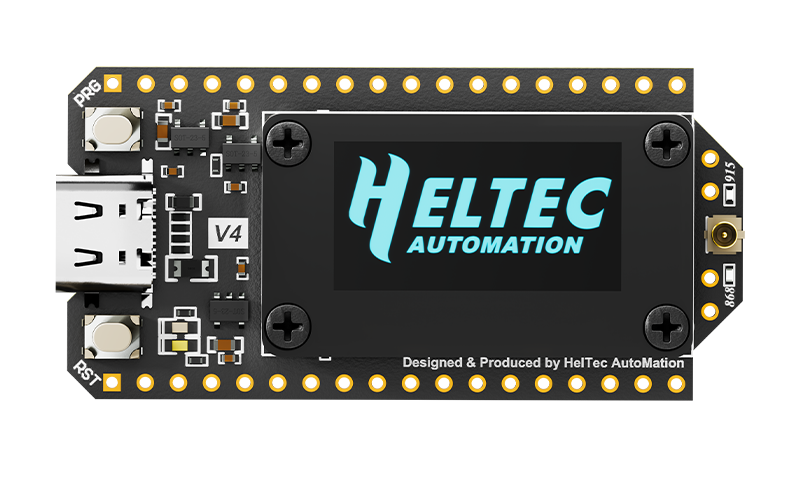
Heltec V4
A compact LoRa development board that can be used with both MeshCore and Meshtastic, making it a useful option if you want to test both projects on similar hardware.
Core philosophy and design differences
This is the real heart of the MeshCore vs Meshtastic comparison.
Meshtastic is built to be broadly usable and easy to join. It wants to be an off-grid communications platform that works for normal users, not just RF tinkerers. That is why the phone apps, maps, node visibility, telemetry, and public community meshes matter so much in its ecosystem.
MeshCore is more opinionated. It is built around the idea that not every node should behave the same way, and that a cleaner mesh comes from deliberate roles and deliberate forwarding behaviour. Companion nodes normally leave forwarding to dedicated repeaters, while room servers have a different job again. Optional companion repeat mode now exists for particular off-grid scenarios, but dedicated repeater infrastructure is still central to MeshCore’s normal design. That is a very different philosophy from a general-purpose “everybody joins the mesh” model.
So while the two projects overlap, they are solving slightly different versions of the problem. Meshtastic is stronger when the priority is accessibility and a rich user-facing experience. MeshCore is stronger when the priority is communications efficiency, topology control, and building a mesh that stays disciplined as it grows.
Ease of setup and onboarding
Meshtastic is still the easier entry point for most first-time users. It has polished Android and Apple apps, a web client, a Python CLI, a mature getting-started flow, and a large body of tutorials and community help. The setup path is straightforward enough that a beginner can often get from new hardware to first message without learning much about mesh design at all.
That said, MeshCore is no longer fair to describe as difficult in the old “serial-only hacker project” sense. It has Android and iPhone apps, web clients, and a web flasher. The app flow is also fairly simple at the companion level: pair your radio over Bluetooth, set a display name, configure radio settings, advertise yourself, and start messaging discovered users.
Where MeshCore gets more technical is when you move beyond a single companion node and start doing what MeshCore is actually good at: dedicated repeaters, room servers, remote administration, and intentional node placement. That is not a weakness so much as the natural result of being a more infrastructure-minded system. So the fairest way to say it is this: Meshtastic is easier to start, but MeshCore is not hard in the same way many older LoRa projects were. It just asks you to think more about the network.
Hardware support
Meshtastic has the broader official hardware ecosystem right now. Its supported-device catalog spans ESP32, nRF52, RP2040, Linux-native systems, Raspberry Pi platforms, and a wide range of hardware families from Heltec, LilyGO, RAK, Seeed, B&Q, Elecrow, and others. It also has a larger number of purpose-built, ready-to-go Meshtastic devices in the market.
MeshCore supports many of the boards makers actually care about, including devices such as the T-Deck, T-Pager, RAK WisBlock/RAK4631 class hardware, Heltec V3/V4, Heltec T114, Seeed T1000-E, XIAO-based boards, Station G2, and Nano G2 Ultra, with more being added over time. That is enough to build serious networks, but the official hardware story is still narrower than Meshtastic’s.
So if your top concern is maximum hardware choice and minimum compatibility risk, Meshtastic is ahead. If your concern is whether MeshCore can run on useful real-world boards for handhelds, repeaters, and fixed nodes, the answer is yes.
Roles, node behaviour, and network structure
This is where MeshCore pulls ahead most clearly for many advanced users.
In the standard structured mesh, MeshCore companion nodes leave forwarding to dedicated repeaters, while room servers can also be configured to repeat. Newer firmware adds an optional companion repeat mode for specific off-grid scenarios, but that is not the default model. Even dedicated repeaters are not there to blindly retransmit everything. They forward traffic toward the destination and minimise unnecessary retransmission, and the project still recommends separate devices for repeater and room-server functions for the best experience.
MeshCore also uses a learned-path model for direct communication. If a path breaks because a repeater disappears, the client can fall back to flooding on the last retry, discover a new path, and use that path going forward. That means the system is not purely fixed-path and not purely flood-based either. It is trying to preserve efficiency without becoming brittle.
Meshtastic does have roles, and it would be wrong to pretend otherwise. It supports roles like client, router, repeater, tracker, and sensor. Since version 2.6, direct messages use next-hop routing after initial path learning, while broadcasts still use managed flooding. The project also offers specific routing features such as favourite routers and zero-cost hops in some scenarios.
But Meshtastic’s own guidance also warns that unnecessary router and repeater use can increase collisions, reduce delivery rates, and decrease effective range. That warning matters. It tells you that Meshtastic can be shaped into a more structured mesh, but that doing so badly can hurt the network. MeshCore, by contrast, is structured that way from the start.
This is one of the biggest reasons many power users are drawn to MeshCore. It is not just “another app for LoRa chat.” It is a network design philosophy.
Messaging and communication features
Meshtastic’s communication model is easier for most people to understand straight away. It has direct messaging, shared channels, node discovery, maps, and optional telemetry. If your idea of success is “I want a useful off-grid chat and map tool on my phone,” Meshtastic is very strong.
MeshCore does not feel as consumer-chat oriented, but that does not mean it is weak at messaging. It supports direct communication through companion radios and adds room servers for shared post-style communication with stored unseen messages. That gives it a more infrastructure-style feel than normal channel chat. It is especially useful for deliberate local networks where not every participant is always active at the same time.
In simple terms, Meshtastic feels more like a messaging product. MeshCore feels more like a communications system.
Range, reliability, and performance considerations
On the same LoRa hardware, antenna and equivalent radio settings, neither MeshCore nor Meshtastic has a magic RF range advantage. Real-world range depends much more on antenna quality, antenna placement, terrain, node height, region, legal power settings, channel width, data rate, local interference, and how many useful relay paths actually exist. A poorly placed node on either platform will still be a poorly placed node.
The more useful comparison is what happens to airtime, routing and congestion once the network starts to grow.
Meshtastic’s design includes routine mesh traffic such as device telemetry, position broadcasts, and NodeInfo broadcasts, though the firmware will scale these intervals back as online-node counts grow and it applies throttling based on channel and airtime utilization. That helps, and it is evidence that the project is actively trying to manage scaling. Still, it also confirms the underlying reality that larger meshes create more contention and that Meshtastic has to work around that.
MeshCore’s design starts from a quieter baseline. Companion nodes normally leave forwarding to deliberately placed repeaters, although optional companion repeat mode now exists for specific off-grid use. Direct messaging uses learned paths instead of flooding every direct message forever. Group channels still flood, because group communication has no single defined path, but repeaters can be configured to limit some flood traffic. That gives MeshCore a stronger story when the goal is keeping the mesh usable as it becomes denser.
The Reddit sentiment around this point is remarkably consistent. Across both MeshCore and Meshtastic discussions, users repeatedly describe Meshtastic as easier to join but more prone to congestion or wasted airtime in dense public meshes, while MeshCore is often described as quieter, more reliable for actual messaging, and better behaved once dedicated repeaters are in place. That is anecdotal, not lab data, but it lines up with the projects’ design choices.
This is the strongest reason to take MeshCore seriously. If your mesh is small and casual, Meshtastic’s extra chatter may not matter much. If your mesh is large, busy, or infrastructure-backed, it can matter a lot.
Offline use and field use
For hiking, camping, events, and casual group travel, Meshtastic is usually the easier fit. The app experience is friendlier, maps are more central, and the project has stronger momentum as a general off-grid social mesh. If the people around you are already on Meshtastic, that alone can decide it.
MeshCore shines more in structured field use. A remote property with a planned repeater, a hilltop relay, a small local network with known coverage paths, or a maker deployment where you want actual comms discipline rather than constant background chatter are all scenarios where MeshCore starts to feel like the better tool.
That does not make MeshCore only for fixed installations. It can absolutely be used in the field. But its strengths show up most clearly when you treat the network as infrastructure, not just as a group chat with radios.
Mobile app and user experience
Meshtastic still has the more polished mainstream user experience overall. The Android app is feature-rich, map-centric, and mature. The software ecosystem includes Android, Apple, web, CLI, and standalone device UI support. If you want something that feels closer to a finished end-user platform, Meshtastic is ahead.
MeshCore’s app story is better than many people realize. It has Android and iPhone apps, web clients, and a straightforward companion-radio flow for day-to-day use. The apps and firmware are still being actively developed, so the gap between MeshCore and Meshtastic on basic usability is much smaller than it used to be.
The difference is less about whether MeshCore has apps and more about what those apps are for. Meshtastic’s software feels built around end-user discovery, maps, and messaging. MeshCore’s software feels built around talking to a deliberately structured radio network. That is a subtle difference, but once you use both, it is hard not to notice.
Home Assistant, MQTT, and integration potential
Meshtastic is still the easier recommendation for Home Assistant and general automation right now. It has official MQTT guidance plus a mature Meshtastic-maintained custom integration for Home Assistant, normally installed through HACS. That integration supports gateway devices, message logging, sending messages, device trackers, triggers, actions, auto-discovery, and MQTT proxy support.
MeshCore is more interesting here than it first appears. It already has a custom Home Assistant integration that can monitor and control nodes over USB, BLE, or TCP, and that integration is under active development. It also has a growing ecosystem around meshcore-ha, meshcore-cli, meshcore.js, meshcore-py, MQTT upload support in the integration, and other tools in the broader project ecosystem. The downside is that it is still clearly less mature than Meshtastic’s automation story.
So the honest answer is this: for plug-and-play smart home integration today, Meshtastic is ahead. For maker-driven self-hosting and custom workflows, MeshCore is becoming very compelling, especially if you care more about disciplined radio behaviour than about the broadest ecosystem.
Power use and remote deployments
Power use is not just a firmware question. It depends on board choice, radio settings, screen use, GPS, Bluetooth, update intervals, and how often the node is actually transmitting. Meshtastic has a lot of hardware built around low-power nRF52 devices, plus settings for tracker and sensor-style roles, and its hardware catalog includes purpose-built solar and handheld options.
MeshCore does not automatically win on battery just because it is quieter, but the architecture helps. A companion device that is not repeating, plus a network where repeaters are there on purpose and direct messages are not endlessly flooding, can produce a cleaner practical power profile in real use. Some users specifically call this out as a reason they prefer MeshCore. That should be treated as a real-world tendency, not a universal guarantee.
For solar-backed repeaters and fixed remote nodes, MeshCore’s model often makes intuitive sense. You know which devices are supposed to do the forwarding work, and you can place and power them accordingly.
Community, ecosystem, and maturity
Meshtastic has the larger and more mature ecosystem. It has broader hardware coverage, more official software surfaces, more how-to material, and more public visibility. That makes it easier to find help, easier to find local users, and easier to buy hardware with confidence.
MeshCore is younger, but it is not stagnant. The main firmware repo is active, the integration ecosystem is growing, and companion, repeater, room-server and supporting projects continue to receive updates. The Home Assistant integration is also still under active development.
That makes the maturity question more nuanced than “Meshtastic is mature, MeshCore is early.” A fairer way to put it is that Meshtastic is the bigger ecosystem, while MeshCore is the more focused ecosystem and is moving quickly.
Reddit sentiment reflects that split. Users stick with Meshtastic because it is easier to join and easier to recommend. Users stick with MeshCore because they feel it behaves better as a communications network and wastes less airtime once the mesh becomes real rather than theoretical.
Security and privacy
Neither platform should be treated as magically secure just because it mentions encryption.
Meshtastic’s channel system uses pre-shared keys, but the default primary channel key is publicly known, so it is not private unless you change it. Meshtastic has also been improving security, including public-key cryptography for direct messages from firmware 2.5 onward, plus admin-key based remote administration and managed-mode controls. Those are meaningful improvements.
MeshCore’s security story is a bit different. Its node advertisements use per-node public keys and Ed25519 signatures, which gives the network a stronger identity model than a simple shared channel key. That said, not every message type provides the same guarantees. Group text messages are documented as unverified, so a displayed sender name should not be treated as strong identity proof. MeshCore also includes administrative controls for repeaters and room servers, which fits its more infrastructure-oriented design.
For ordinary hobby messaging, both platforms can provide useful privacy when configured correctly, but neither should automatically be treated as a hardened secure communications system. Change default keys and passwords, understand which channel or message type you are using, and check the current security documentation before relying on either platform for anything sensitive.
Which one is better for different types of users?
| Use case | Better starting point | Why |
|---|---|---|
| Beginner | Meshtastic | Easier onboarding, larger community and broader app ecosystem |
| Casual off-grid messaging | Meshtastic | More polished phone-first messaging, maps and node discovery |
| Hiking and travel | Meshtastic | Usually easier for portable groups, although MeshCore companion repeat can help where there is no repeater infrastructure |
| Makers and network tinkerers | MeshCore | More emphasis on node roles, routing, repeater placement and network design |
| Remote property or planned fixed network | MeshCore | Dedicated repeaters and explicit infrastructure roles suit designed coverage |
| Home Assistant | Meshtastic | More mature integration options today |
| Easiest phone experience | Meshtastic | More polished mainstream app experience |
| Role-based or experimental network | MeshCore | Better fit if the network architecture itself is part of the project |
Can they coexist, or are they direct substitutes?
No. A MeshCore node cannot directly communicate with a Meshtastic node over the mesh. They use different firmware and networking protocols. The same hardware family may support both projects, but the device must be flashed for one platform at a time.
So yes, they are competitors in the sense that many users will choose one or the other for the same budget and the same radios. But they are not clones. Choosing between them is not just choosing a feature list. It is choosing whether you value broad adoption and app convenience more, or whether you value a quieter, more intentional network design more.
Final verdict
If your priority is the easiest path into LoRa mesh, Meshtastic is still the safer recommendation. It is easier to start with, easier to use from a phone, easier to join in many places, and backed by a larger overall ecosystem. For casual off-grid communication, group trips, and people who want something that feels immediately useful, it remains a strong choice.
But if your priority is building a mesh that behaves well as it grows, wastes less airtime, uses repeaters on purpose, and feels more like communications infrastructure than a social radio app, MeshCore deserves much more credit than it often gets. In that kind of comparison, MeshCore is not just an interesting alternative. For many advanced makers, remote-property users, repeater builders, and infrastructure-minded tinkerers, it may be the better platform overall.
The simplest way to choose is this:
If you want the easiest phone-first LoRa mesh experience, pick Meshtastic.
If you want a quieter, more deliberate, role-based mesh that makes stronger sense once the network becomes serious, pick MeshCore.