If you want to get into electronics without buying every part separately, a starter kit is an easy way in. I would not choose one just because it has the biggest parts count. Good tutorials and a sensible selection of components matter more when you are working through your first few projects.
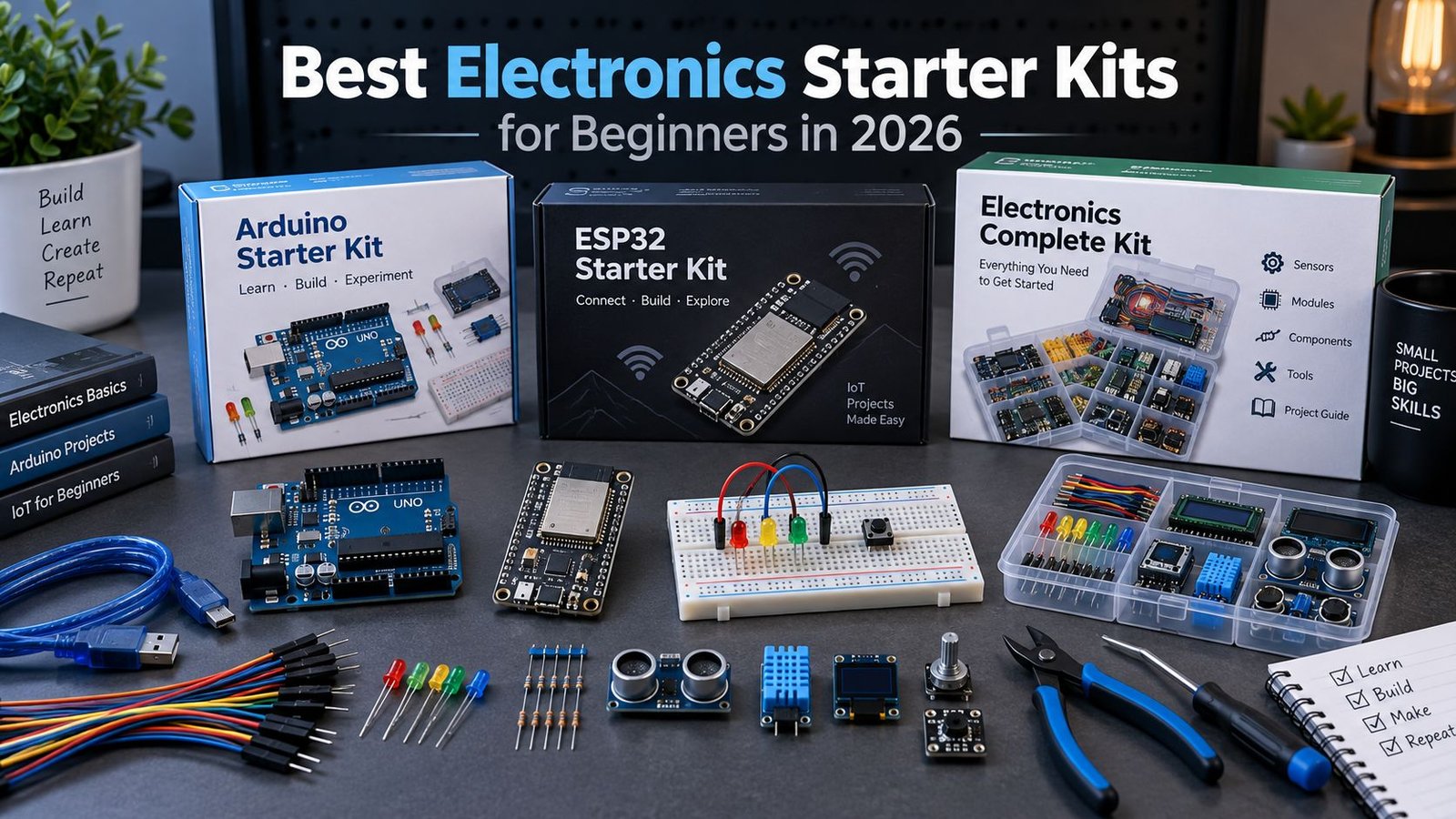
For most complete beginners, I would start with the Arduino Starter Kit R4 if structured learning matters more than price, or the Keyestudio Super Starter Kit if you want a lower-cost Arduino-style option with plenty of guided projects. If your end goal is Wi-Fi, Home Assistant or connected sensor projects, the SunFounder ESP32 Ultimate Starter Kit is the more relevant option.
If you would rather build your own setup with a multimeter, soldering iron, breadboard and hand tools, see my separate guide to electronics tools and components for beginners.
Best Electronics Starter Kits: Quick Comparison
| Starter kit | Best for | Main platform | Learning material |
|---|---|---|---|
| Arduino Starter Kit R4 | Best structured beginner experience | Arduino UNO R4 WiFi | Printed book, 13 guided projects and online resources |
| Keyestudio Super Starter Kit | Best lower-cost Arduino-style option | UNO R3-compatible | 32 guided projects |
| Freenove Ultimate Starter Kit | Best detailed tutorial | UNO R4 WiFi-compatible | 399-page tutorial and 78 projects |
| SunFounder ESP32 Ultimate | Best for Wi-Fi, IoT and ESP32 | ESP32 | 100+ projects and 50+ video tutorials |
| SparkFun Inventor’s Kit | Best project-led alternative | Arduino or MicroPython options | 16 circuits across five projects |
1. Arduino Starter Kit R4: Best Overall for Structured Learning
The Arduino Starter Kit R4 is the easiest recommendation if you want a polished, step-by-step introduction rather than a box full of parts and a PDF you may never open.
It is built around the UNO R4 WiFi, so you are learning on a current Arduino board rather than an older UNO R3 clone. The kit includes a breadboard, jumper wires, LEDs, buttons, sensors, a servo, DC motor, LCD, motor driver and the usual components needed to work through beginner circuits.
The biggest advantage is the learning material. Arduino includes a printed project book with 13 guided projects, online content after registration and a voucher for the Arduino Fundamentals certification exam. The UNO R4 WiFi also gives you built-in Wi-Fi and Bluetooth through its onboard ESP32-S3 module, so you are not limited to completely offline projects once you get past the basics.
Best for: someone starting from zero who values clear instructions and an official learning path.
Main drawback: you pay more for the official board, documentation and course experience. If your priority is getting the largest possible pile of sensors and modules for the money, one of the compatible kits below will stretch further.
2. Keyestudio Super Starter Kit: Best Lower-Cost Arduino-Style Option
The Keyestudio Super Starter Kit is a practical alternative if you want to spend less than the official Arduino kit while still getting a controller board, common modules and a structured set of projects.
Keyestudio currently lists 32 guided projects, starting with basic circuits and moving into modules such as RFID plus temperature and humidity sensing. The kit includes an UNO R3-compatible board and is designed around detailed wiring diagrams and example code rather than simply maximising the number of loose components in the box.
The UNO R3-style platform is older and lacks native Wi-Fi and Bluetooth, but it remains straightforward for learning digital and analogue I/O, sensors, displays and basic embedded programming.
Best for: beginners who want a lower-cost Arduino-style kit with a decent number of guided projects.
Main drawback: if connected or smart-home projects are your main goal, an ESP32-based kit will get you there with less hardware swapping later.
3. Freenove Ultimate Starter Kit: Best for Detailed Tutorials
The current Freenove Ultimate Starter Kit uses an UNO R4-compatible platform rather than the older R3 design.
Freenove currently lists 220 items, 78 projects and a 399-page detailed tutorial. The WiFi version uses a 48 MHz Arm Cortex-M4 controller with an onboard ESP32-S3 and 12×8 LED matrix, while the tutorial covers basic electronics, programming and progressively more involved projects.
Best for: people who want a large amount of guided material and a newer R4-generation learning platform.
Main drawback: the documentation is extensive, but it is downloadable rather than the polished printed-book experience you get with the official Arduino Starter Kit R4.
4. SunFounder ESP32 Ultimate Starter Kit: Best for ESP32 and IoT
If the reason you are learning electronics is to build Wi-Fi sensors, smart-home devices or other connected projects, I would skip the UNO route and look at the SunFounder ESP32 Ultimate Starter Kit.
The kit is built around ESP32 and SunFounder lists 320+ items, 100+ projects and 50+ video tutorials. The learning material covers Arduino C++, MicroPython and Scratch, and the project list extends into Bluetooth, IoT and smart-home use rather than stopping at basic offline circuits.
If you want to move into MQTT, Home Assistant or web-connected sensors, the built-in Wi-Fi and Bluetooth are useful straight away. My ESP32 beginner’s guide is a good next step if that is where you are heading.
If you are unsure whether ESP32 or Arduino is the better starting point, my ESP32 vs Arduino vs Raspberry Pi comparison goes through the practical differences.
Best for: beginners who already know they want to build connected devices, IoT projects or smart-home hardware.
Main drawback: ESP32 gives you more capability, but it also adds more setup choices than a basic UNO. If you only want the simplest possible first programming and electronics lessons, Arduino’s guided path is easier to follow.
5. SparkFun Inventor’s Kit: Best Project-Led Alternative
The SparkFun Inventor’s Kit is worth considering if you would rather work through a smaller number of carefully designed projects than buy the kit with the most parts.
SparkFun structures the kit around 16 circuits across five projects, with circuit diagrams and hookup guidance. The projects build on one another and culminate in a more involved final build rather than treating each sensor as an isolated example. SparkFun also offers Arduino and MicroPython-oriented versions of the learning path.
Best for: someone who prefers project-based learning and good documentation over maximum component count.
Main drawback: it is not the cheapest way to accumulate components. You are paying for a more curated learning experience.
Which Electronics Starter Kit Should You Buy?
If you are completely new and do not yet know what direction you will take, the Arduino Starter Kit R4 is the safest all-round choice because the hardware and learning material are designed as one package.
If budget matters most, the Keyestudio Super Starter Kit is the lower-cost option here. If you enjoy following detailed written lessons and want a newer R4-generation board, Freenove Ultimate is particularly strong. If you already know you want Wi-Fi, Bluetooth, Home Assistant or IoT, I would go straight to the SunFounder ESP32 Ultimate instead.
A huge 300-piece kit is not automatically better if the tutorials are poor or the board does not suit the projects you actually want to build.
What Should a Good Beginner Electronics Kit Include?
Whatever brand you choose, I would look for a kit with the following basics:
- A supported development board with plenty of current documentation
- A full-size breadboard and enough jumper wires to build projects properly
- Common resistor values, LEDs, pushbuttons and potentiometers
- At least a few useful sensors rather than dozens of obscure modules
- A servo or small motor so you can learn outputs and basic control
- A display such as an LCD or OLED
- Clear wiring diagrams and project instructions that match the exact parts in the box
I would put tutorial quality above raw component count. A smaller kit that takes you through 15 useful circuits is a better first purchase than a 300-piece box that leaves you searching the internet to identify half of it.
Arduino or ESP32 for a First Electronics Kit?
Arduino remains the easier traditional learning path. The UNO ecosystem is predictable, there are enormous numbers of beginner tutorials, and most starter-kit lessons assume the same basic style of board.
ESP32 is the better fit when wireless connectivity is part of why you are learning electronics in the first place. Built-in Wi-Fi and Bluetooth mean you can move from basic circuits into MQTT, web interfaces, Home Assistant and connected sensors without replacing the controller.
Choose Arduino if you want the simpler learning path. Choose ESP32 if wireless and connected projects are the reason you are getting into electronics.
Do You Still Need a Multimeter and Soldering Iron?
Not immediately. Every kit in this guide is designed around solderless breadboards, so you can work through the early lessons without soldering anything.
A multimeter becomes useful surprisingly quickly because it lets you check voltage, continuity and resistance instead of guessing when a circuit does not work. A soldering iron matters later when you move from temporary breadboard circuits to permanent projects.
For the separate tools I would add as you progress, see Electronics Tools and Components for Beginners.
Common Starter Kit Mistakes
- Buying purely by component count. More parts are only useful if you know what to do with them.
- Ignoring the tutorial quality. Good documentation is one of the main reasons to buy a kit instead of loose components.
- Choosing UNO when your only goal is Wi-Fi projects. An ESP32 kit may save you from replacing the controller almost immediately.
- Buying advanced tools before you need them. You do not need an oscilloscope, bench power supply or logic analyser to work through your first projects.
- Expecting one kit to contain everything forever. A starter kit is there to teach you what you want to build next.
Frequently Asked Questions
What is the best electronics starter kit for a complete beginner?
The Arduino Starter Kit R4 is the strongest all-round option if you want clear guided learning and do not mind paying more for the official kit. The Keyestudio Super Starter Kit is the lower-cost choice if you want an Arduino-style board and a solid set of guided projects.
What is the best electronics kit for ESP32 projects?
The SunFounder ESP32 Ultimate Starter Kit is the most relevant option here because it combines an ESP32 board with a large component set and tutorials that extend into Wi-Fi, Bluetooth and IoT projects.
Should I buy a kit or individual components?
A kit is usually easier for your first few projects because the tutorial and component list are matched. Once you know which kinds of projects you enjoy, buying individual boards, sensors and tools makes more sense.
Do beginner electronics kits require soldering?
No. Most beginner kits use a solderless breadboard and jumper wires. Soldering becomes useful later when you want to turn a prototype into something permanent.
Final Recommendation
For a first kit, I would prioritise the tutorials and project path over the size of the parts list.
- Arduino Starter Kit R4: best if you want the most structured introduction.
- Keyestudio Super Starter Kit: best if you want a lower-cost Arduino-style option with guided projects.
- Freenove Ultimate: best if detailed written tutorials and a newer R4-generation platform matter most.
- SunFounder ESP32 Ultimate: best if you are learning electronics for IoT, Wi-Fi or smart-home projects.
- SparkFun Inventor’s Kit: best if you prefer a curated project-based learning path.
Once you have worked through a starter kit and know what you actually enjoy building, that is the point where it makes sense to start buying individual boards, sensors and tools around your own projects.